

Call Today For A Free Consultation
Call Today For A Free Consultation
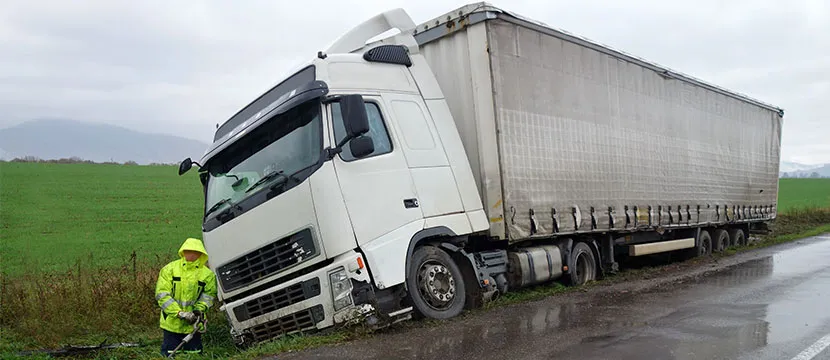
Over half a dozen major interstates converge on the city of Chicago, which is also home to a major international port and one of the busiest air cargo gateways in the world. It is, therefore, not surprising to see truck traffic on the city streets and highways of Chicagoland at all hours of the day and night.
While vital to the economy, the number of semi trucks crisscrossing the city throughout the year increases the likelihood of a Chicago truck accident.
While they occur less frequently than car accidents, a collision with a tractor-trailer is much more likely to result in serious injury or death to the occupants of the passenger vehicle.
According to the Illinois Department of Transportation, crashes involving tractor-trailers in 2024 made up only 3.7% of all crashes in the state, yet accounted for 2.8% of injury crashes and a disproportionate 8.4% of all fatal crashes.
The Chicagoland truck accident attorneys at D&W Law Group have handled numerous car and trucking injury cases over the years, including cases involving catastrophic injury or wrongful death.
We approach your case with compassion and sensitivity to what you have been through while working aggressively to obtain a financial settlement that most fully and fairly compensates you for your damages. Our firm’s founding partners, Lance C. Dale and Scott B. Wolfman, have each practiced Illinois personal injury law for more than three decades, and that longevity means our team has already seen almost every defense a trucking company’s insurer will try to raise.
Many aspects of semi trucks make them more likely to cause serious injury or worse in a collision with a passenger car. Tractor-trailers are many times larger than even the largest SUV, and when fully loaded, they can weigh 20 to 30 times more than a passenger vehicle. At highway speeds, the force of an impact with a semi is enormous.
The size of commercial trucks also creates extensive blind spots on all sides of the semi, requiring constant attention and caution on the part of the truck driver. Unfortunately, the pressure on truckers to deliver their cargo on schedule often leads them to drive longer than is safe, and critical lapses of attention or mistakes in judgment can occur.
Our investigation of countless trucking accidents throughout Chicago reveals several recurring factors that often lead to devastating collisions. Understanding these causes helps establish liability and build stronger cases for our clients:
These preventable circumstances often result from trucking companies prioritizing profits over safety.
Different types of truck accidents present unique dangers and require specific approaches to investigation and evidence gathering. Our experience handling Chicago truck accidents includes:
Each accident type requires a thorough investigation to determine liability and identify all responsible parties.
The moments following a truck accident prove critical for protecting both your health and legal rights. Taking appropriate action can significantly impact your ability to recover fair compensation:
Following these steps creates a strong foundation for your injury claim while protecting your interests against trucking companies and their insurers.
Federal regulations govern many aspects of the trucking industry, including truck safety. The regulations of the Federal Motor Carrier Safety Administration (FMCSA) limit the number of hours that truckers may be on duty or behind the wheel without taking days off or significant rest periods.
These regulations also cover licensing issues, size and weight limits, and mandate regular inspections and maintenance to ensure a safe trucking fleet. However, it is well-known that truck drivers and trucking companies routinely violate these regulations and even falsify records to hide their noncompliance.
During annual roadside safety inspections, thousands of drivers and vehicles are immediately pulled from service for dangerous conditions such as unlicensed drivers, drivers working beyond the hours of service limitations, and trucks with out-of-adjustment brakes, bad tires, non-working signal lights and more.
Here at D&W Law Group, we have prosecuted many trucking injury cases through the years, and we know how to build your case against the trucking companies. Our lawyers are thoroughly familiar with the FMCSA rules and can determine whether regulation violations caused or contributed to the truck accident.
Our Chicago truck accident attorneys leave no stone unturned in finding all liable parties responsible for the accident and the harm they have caused to you.
Driver fatigue is not just a common-sense concern, it is the subject of a specific federal rule that trucking companies and drivers are required to follow on every load that crosses through Chicago.
A driver may not drive after a period of 14 consecutive hours after coming on-duty following 10 consecutive hours off-duty, and a driver may drive a total of 11 hours during that period.
This means a trucker who has been on duty since early morning, loading, inspecting, and driving through Chicago’s interstate interchanges, is legally required to stop driving once the 14-hour window closes, even if delivery deadlines say otherwise.
When we build a Chicago truck accident case, we request the driver’s electronic logging device data, dispatch records, and fuel receipts to check whether the 11-hour driving limit was exceeded. A documented hours-of-service violation is powerful evidence that a fatigued driver, not just bad luck, caused your crash.
Illinois law does not give truck accident victims an unlimited amount of time to bring a lawsuit.
Illinois law provides that actions for damages for an injury to the person “shall be commenced within 2 years next after the cause of action accrued.” That two-year filing deadline applies to most truck collision injury claims, but it can run out faster than it seems once medical treatment, an insurance investigation, and negotiations with a trucking company’s lawyers eat into the calendar.
Claims involving a government-owned vehicle, such as a municipal dump truck or CTA bus, may carry a much shorter deadline and separate notice requirements, so we recommend speaking with a truck accident lawyer as soon as possible after your crash rather than waiting.
Trucking companies and their insurers often try to shift blame onto the injured driver to reduce what they owe. Under Illinois’ modified comparative negligence rule, an injured party may recover damages only if they are less than 50% at fault for the crash, and the recovered amount is reduced in proportion to the degree that the injured party was at fault.
In practice, that means if a jury finds you 20% responsible for a collision with a semi, your total recovery is reduced by that same 20%, but you are not barred from compensation.
If you are found more than half at fault, however, Illinois law prevents you from recovering anything at all, which is exactly why insurance adjusters push so hard to inflate a victim’s share of blame in the days after a wreck.
A car accident usually involves one at-fault driver. A truck accident often involves several parties whose decisions, months or years before the crash, contributed to what happened on the road. Our investigation typically examines:
Because more than one party can share fault, we send preservation letters early to lock down black box data, driver logs, and maintenance records before a trucking company’s insurer has a chance to lose or overwrite them.
Most serious Chicago truck accident claims, where damages exceed $30,000, are filed in the Law Division of the Circuit Court of Cook County rather than the Municipal or Civil Division. The Law Division hears civil suits for recovery of monetary damages in excess of $30,000 in the city of Chicago, and in excess of $100,000 in the suburban districts.
That threshold covers the great majority of tractor-trailer collision cases, given the severity of injuries these crashes typically cause.
The Law Division sits inside the Richard J. Daley Center, located at 50 West Washington Street, Chicago, Illinois 60602, where the Law Division’s motion section judges sit on the courthouse’s 22nd floor.
Our attorneys regularly appear in this courthouse to file suit, argue motions, and, when a trucking company’s insurer refuses to offer fair value, take a case in front of a Cook County jury.
D&W Law Group has recovered significant verdicts and settlements in commercial vehicle, bus, and motor vehicle injury claims across Chicagoland. Prior results reflect the range of outcomes our firm has obtained in similar cases:
| Outcome | Case Type |
|---|---|
| $6.5 million | School bus accident causing back, carpal tunnel, and rib injuries |
| $3.6 million | CTA accident causing a fractured pelvis in an elderly woman |
| $2 million | Pedestrian struck by a bus, resulting in hip fracture, sepsis, and death |
| $1.25 million | Car accident causing a disc herniation |
Prior results do not guarantee a similar outcome.
Trucking companies show up to every claim with an insurance adjuster, a defense lawyer, and a rapid-response team trained to limit what they pay. We built our firm to meet that resistance head-on.
If you were hurt in a semi-truck, delivery van, or commercial bus crash anywhere in Chicago, Cicero, Evanston, or the surrounding suburbs, our attorneys can start investigating the same day you call.
Contact D&W Law Group for a free consultation about

Not necessarily, but you should have a lawyer review any offer before you accept it. Trucking companies and their insurers often make an early offer that is far below the true value of a serious injury claim, especially before you know the full extent of your medical treatment.
Truck accident cases usually involve multiple potentially liable parties, federal safety regulations, and evidence like electronic logging device data and black box recorders that do not exist in a typical car accident case.
Chicago’s expressway system, including the Kennedy, Dan Ryan, and Eisenhower, carries enormous truck volume at highway speeds, which tends to produce more severe injuries. Get to safety, call police to the scene, seek medical care, and avoid giving a recorded statement to the trucking company’s insurer until you have spoken with an attorney.
Most truck accident claims settle before trial, but a trucking company’s insurer negotiates harder when it does not believe your attorney is prepared to try the case. We prepare every truck accident case as though it is headed to a Cook County jury, which tends to improve settlement offers long before a trial date is ever set.
Ownership structures in trucking are often deliberately complicated, involving separate leasing companies, motor carriers, and independent owner-operators. Our investigation traces who actually controlled the truck, the driver, and the load, since more than one entity can share legal responsibility for a Chicago truck accident.
Case value depends on the severity of your injuries, your medical expenses, lost income, and the degree of fault assigned to each party. Our case value resource walks through the factors that go into calculating fair compensation, though every truck accident claim is different.
Speak with an attorney about the specific facts of your crash. Comparative fault arguments in Illinois look at what caused the collision and the resulting injuries, and an experienced truck accident lawyer can help you understand how any potential fault issues might affect your claim before you talk to an insurance adjuster.
No. Consultations are free, and our firm does not charge a fee unless we recover compensation for you.
If you or a loved one has been hurt in a tractor-trailer, delivery truck, or commercial bus accident in the greater Chicago area, our attorneys are ready to review what happened and explain your options in plain terms. Your initial consultation is free, and there is never any fee if we can’t recover for you.

I was in a accident and D&W Law group took very grate care of me and I would recommend this law group to any one if you were in a car accident please call this law group there are great.
I come from the "Service" industry with a predominantly Hispanic customer base and I am very particular as too whom I refer my customers to when they need assistance. D&W has pulled thru every time taking care of my customers as I would. Thank you for all you do!
After what seemed like an impossible search, I was referred to D and W Law Group. I was met with a very knowledgeable staff who exceeded my expectations. All of my questions and concerns were answered in a timely manner.
I just have a question ik it's been a while since I had my accident. I just wanted to know if I'm still having complications do to my injury what do you suggest I do can you all give me a call or can I call to talk more details…
Pros 100% Font bother going anywhere else. They actually care about doing good and put the thier clients best interest 1st. I hope I never need help in this way again but if I did I wouldn’t go anywhere else.

Get trusted guidance from Chicago personal injury attorneys who know how to stand
up to insurance companies.
Fields marked with an * are required
"*" indicates required fields

Personal Representation From Experienced, Dedicated And Successful Chicago Personal Injury Lawyers
© 2026 D&W Law Group • All Rights Reserved.
Disclaimer | Site Map | Privacy Policy | Digital Marketing By: 
*Images are obtained under license from Canva and other third-party stock image providers, with attribution included where required.